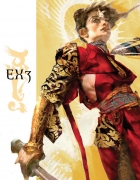

Overview of Feng Shui 2:
The original Feng Shui Roleplaying game came out in 1996 just as Hong Kong action movies were first hitting their stride in the United States. Movies like Rumble in the Bronx with Jackie Chan introduced a new group of movie goers to the high flying, fast paced, over the top style of Hong Kong action cinema. Robin D. Laws and Feng Shui first edition brought quick moving, action-packed combat filled with spells, gun play and kung fu to tabletops everywhere.
Launched on Kickstarter in 2014, Feng Shui 2nd Edition was funded in just 20 minutes. I recently picked up the hefty 347 page full color book and gave it a test drive.
Core Mechanics:
Feng Shui 2 is built to create opportunities for incredible success as well as massive failure. In this regard it can be a bit swingy with the results you get, but that is the point!
Dice Mechanic:
Each character has skills (including combat skills) that give you an Action Value (AV). You roll two six-sided dice - one is your positive die, one is your negative die. You subtract your negative die result from your positive die result to get your Swerve.
On skill checks, dice explode on a 6…both positive and negative. Roll the exploding die again, and add that number to the 6 you already rolled. Dice can explode multiple times…in our game the dice seemed to explode multiple times as a rule. Certainly this was an outlier, but it made for some crazy successes and epic failures!
Next take your Action Value and add your Swerve. This is your Action Result. Subtract the Difficulty (or Defense if it’s an attack) from the Action Result to get your Outcome. An Outcome of zero (exactly met the Difficulty) or better is a success. An Outcome of +4 or better will allow you to perform a Stunt…basically you can accomplish something else cool in addition to your successful attack.
On an attack, the Outcome plus your Weapon Damage is called your Smackdown. The target receives Wound Points equal to the Smackdown minus their Toughness. Mooks go down automatically on any hit, they don’t receive Wound Points.
So to recap:
- Positive d6 - Negative d6 = Swerve
- Action Value + Swerve = Action Result
- Action Result - Difficulty = Outcome
- Outcome of +4 or better lets you perform a Stunt
- Weapon Damage + Outcome = Smackdown
- Smackdown - Target’s Toughness = Wound Points received
It’s not hard in practice, but there is a lot of simple math involved.
There are a couple more dice mechanics to be aware of that can really amp up the intensity of the action. If you get a negative Action Result (your Action Value + Swerve = a negative number), then you experience a Way-Awful Failure. Basically at this point the GM gets to make you suffer.
If you roll a 6 on both your positive and negative dice, this is called boxcars. They don’t explode, but instead you roll both dice again. If you get a positive Swerve, something awesome happens. If on the reroll you get a negative Swerve, then hello Way-Awful Failure.
Each player has a resource pool that equates to their Fortune. Depending on the character type you are playing, it may also be called Chi, Magic or Genome — but it’s all the same. You can add a Fortune die result to your Swerve roll or to your Defense when attacked. Fortune die do not explode.
Combat Rounds:
Feng Shui 2 doesn’t use traditional combat rounds, but instead uses Sequences and Shots. It kinda helps to think of Shots as “screen time” that the actor/actress is getting before cutting to another shot. For example, in a 3-Shot move you can attack an opponent, pick up an object or reload a submachine gun.
Initiative is determined by rolling a single six-sided die (doesn’t explode), and adding the total to your speed. This will determine which Shot you start on. As you perform attacks, dodge enemies and use other abilities called Schticks, you move down the shot chart.
When all characters have gone off the chart, the Sequence is over. You roll Initiative again and start over.
Character Creation:
Character Creation is super simple in Feng Shui 2, which makes it a great game for new players and One Shots. Character creation can be as simple as choosing one of 35 archetypes, giving them a name, basic character concept and a melodramatic hook.
Here’s a list of the 35 archetypes you’ll find in Feng Shui 2:
|
|
|
Your archetype choice provides you with all the stats and schticks (special abilities) your character will start with. You will need to come up with your character’s concept, which is really just the basic concept of what makes your character more specific. In other words, you aren’t just any Everyday Hero — you are Jack Burton hard-boiled truck driver and loyal friend.
Your melodramatic hook is the emotion driven plot device that the GM can use to draw you into the story, and create consequences for your action…or inaction.
Examples include:
- Your Maverick Cop is full or remorse from being unable to save his wife when their car toppled off a bridge into the water.
- Your Two-Fisted Archeologist has sworn to clear the name of her late father who was accused of assassinating a political leader.
- Your Driver is an undercover officer who dreads the day he has to betray his Triad brothers.
Add a cool name, and you are ready to play!
Schticks:
As you progress through a campaign, you’ll have the opportunity to “Awesome Up” by adding/increasing skills, improving attack values, and adding new Schticks to your character.
Schticks are the special abilities that make your character tick. They demonstrate why you are an action hero, and give your character mechanical benefits for this awesomeness. Each archetype begins with several schticks. Schticks fall into one of the following categories:
- Core Schticks
- Gun Schticks
- Fu Schticks
- Driving Schticks
- Sorcery Schticks
- Creature Schticks
- Transformed Animal Schticks
- Mutant Schticks
- Scroungetech Schticks
- Foe Schticks
Here’s an example of one that came into play during our session - the Karate Cop’s Ouch! schtick.
Ouch! - when you miss with an unarmed attack, you take X Wound Points, where X equals the absolute value of your Swerve. Your next Martial Arts attack this fight gets a +X bonus. If successful, heal X Wound Points. This schtick is always active.
Our resident Karate Cop, Chief Inspector Lee, had horribly whiffed as he attempted to roundhouse kick the Triad gang leader. His -6 Swerve result caused him to crash his shin into a stone pillar taking 6 Wound Points because of the Ouch! schtick. However, Chief Inspector Lee now was able to add +6 to his next Martial Arts attack.
With this bonus in hand, the player declared that he was going to attack 4 mooks at once (a -4 penalty, 1 per foe attacked). He rolled successfully, and our hero was able to harness his pain to wipe out a group of low level Triad flunkies. This was a highly cinematic moment in our game, and put a huge grin on my 15 year old’s face as his Karate Cop went to work.
The Setting:
The setting for Feng Shui 2 is a tweaked version of the original Chi War setting. Chi Warriors navigate through time via portals into the Netherworld as factions battle for control of feng shui sites in order to shape the history of the world.
The Netherworld gives characters access to four major time periods called Junctures.
- Ancient - 690 AD
- Past - 1850
- Contemporary - modern day
- Future - 2047 post-apocalyse
Pop-up Junctures give temporary access to other time periods, but must be used with caution as they can close without warning, trapping the characters forever.
This is a wild and crazy setting, but one that allows ancient sorcerers to mix it up with modern day cops and techno-monsters from the future.
Not interested in the Chi War? You can toss aside the default setting if you want to focus in on a specific genre of action film.
You can easily play…
- Modern Action like Die Hard
- Wuxia like Crouching Tiger, Hidden Dragon
- Down-to-Earth Martial Arts like Drunken Master
- Post-Apocalyptic like Mad Max
The GM section of the book details how to tweak the archetype choices for each of these genres to run the action movie style you desire.
Final Thoughts:
Feng Shui 2 is a rolling romp of a good time. It does what it does well, and it doesn’t apologize!
We ran the Red Packet Rumble demo scenario from the Atlas Games website for our play test. This is a simple scenario that includes a modern day fight against Triad gangsters, a magic filled battle in the Netherworld, and 12 different archetypes you can preview for yourself.
The production quality of the book itself is top notch, and the GM Screen is full of useful info to keep the game running smoothly. Much of what you need to run the game is contained on the character sheets and GM Screen. After reading through the rules, we only had to reference the rulebook once or twice during our 3 hour session. Pretty incredible for our first time running the game!
Resources:
- Feng Shui 2 Core Rulebook
- Feng Shui 2 GM Screen
- Secrets of the Chi War - expanded setting info & adventures
- Red Packet Rumble demo scenario
- Sylvan Master app - manage the shot counter and more
- Feng Shui 2 - Mook Attack Tool - makes rolling for mook attacks quick & easy
- One Shot Podcast - actual play podcast of a Feng Shui 2 session
- Play Better Podcast - another actual play podcast of a Feng Shui 2 session
 Follow Our RSS Feed